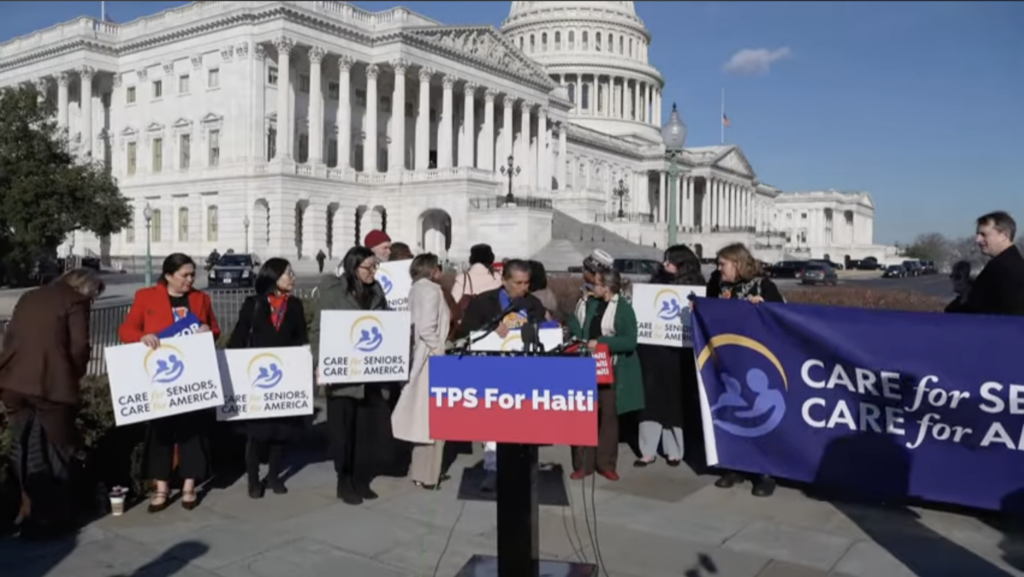
Congress voted on Thursday to extend Temporary Protected Status (TPS) for Haitians by an additional three years. This decision has drawn significant criticism regarding the interpretation of the term "temporary" in immigration policy. Critics argue that such extensions undermine the original intent of TPS, which was designed to provide short-term relief in response to specific crises affecting individuals from designated countries.
The extension comes at a time when the Biden administration continues to face scrutiny over its immigration policies, particularly concerning the influx of unauthorized immigrants at the southern border. The TPS program, initially established to assist individuals from countries experiencing significant turmoil, has been criticized for evolving into a de facto long-term solution rather than remaining a temporary measure as originally intended.
Haitians were first granted TPS in 2010 following a devastating earthquake that caused widespread destruction and loss of life. Since then, the status has been renewed multiple times, citing ongoing political instability, violence, and humanitarian crises in Haiti. Theo Wold, a former deputy assistant to President Donald Trump, highlighted this issue on social media, stating, "Somalians first received TPS in 1991. Haitians first received TPS in 2010. Both were supposed to last 18 months but continue until this day. Mass migration didn’t take over America overnight. It happened through years of ‘temporary’ exceptions."
Background on TPS
The TPS program allows individuals from designated countries to remain in the United States temporarily if conditions in their home countries prevent them from returning safely. However, the law does not specify how long a designation should last once conditions improve, which has led to indefinite extensions in some cases. Critics argue that this lack of clarity has allowed the program to be exploited, turning what was meant to be a temporary solution into a long-term status for many individuals.
In recent months, the Biden administration has faced challenges related to border security and immigration enforcement. Reports indicate that during a surge in border crossings, over 15,000 Haitians entered the U.S. illegally. Many of these individuals reportedly discarded identification and paperwork from other countries to make asylum claims upon arrival. Bill Melugin of Fox News reported that former Homeland Security Secretary Alejandro Mayorkas acknowledged that more than 12,000 of these individuals were released into the U.S., raising further concerns about the administration's handling of immigration issues.
Political Reactions
The decision to extend TPS for Haitians was supported by a bipartisan group of lawmakers, with ten Republicans joining Democrats in the vote. However, this has not quelled criticism from those who argue that the program's extensions are indicative of a broader trend of misusing the term "temporary" in legislation. Wold's comments reflect a growing concern among some Republicans that the extension of TPS is part of a pattern where temporary measures become permanent fixtures in U.S. policy.
While some lawmakers defend the extension as necessary for humanitarian reasons, critics maintain that it sets a dangerous precedent. They argue that labeling policies as "temporary" makes them easier to implement but harder to revoke once established. This sentiment echoes in other areas of policy, such as the Deferred Action for Childhood Arrivals (DACA) program, which was also framed as a temporary solution but has persisted for years, creating ongoing debates about its future.
Broader Implications
The implications of this extension extend beyond immigration policy. Critics suggest that the ongoing use of temporary measures can lead to significant shifts in demographics and political landscapes, particularly in states like Virginia, where Democrats are proposing redistricting maps described as "temporary." This raises concerns that such measures may be used strategically to benefit one party over another, further complicating the political environment.
As the debate continues, supporters of TPS argue that the program is essential for protecting vulnerable populations who cannot safely return to their home countries. However, critics assert that the repeated extensions undermine the integrity of immigration law and contribute to a perception of lawlessness at the border, complicating the already contentious issue of immigration reform in America.
In conclusion, the extension of TPS for Haitians has reignited discussions about the meaning of "temporary" in U.S. policy, with implications for immigration, political representation, and legislative integrity. As the situation evolves, both supporters and critics of the policy remain vocal, reflecting the ongoing complexities of immigration reform in America and the challenges that lie ahead.