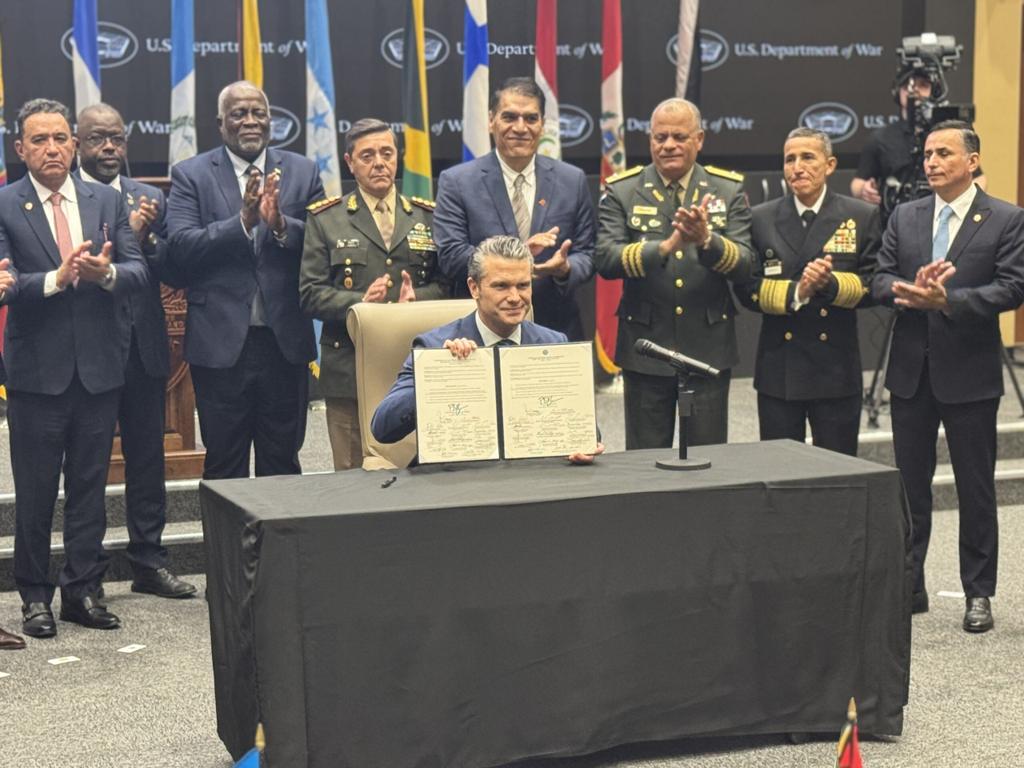
U.S. Secretary of War Pete Hegseth signed a joint security declaration on Thursday with 17 countries in the Western Hemisphere, aiming to establish a unified front against narcoterrorism. The agreement was reached during a meeting at the U.S. Southern Command (SOUTHCOM) headquarters in Doral, Florida, where defense officials from South America, Central America, and the Caribbean gathered to discuss regional security challenges.
The declaration underscores the growing concern about the influence of narcoterrorists in the region and their impact on U.S. national security. Hegseth emphasized that threats from drug cartels and terrorist organizations pose risks not only to the United States but also to neighboring countries.
During the conference, Hegseth stated, "When terrorist killers and cartels capture strategic infrastructure, resources, and entire towns or cities close to U.S. borders, that is a threat to the United States homeland and a threat to all of you as well — to the Americas."
Joint Security Declaration
The Americas Counter Cartel Conference Joint Security Declaration reaffirms the sovereignty of each participating nation while committing to enhance multilateral and bilateral cooperation to combat narcoterrorism and other security threats. The countries involved include the Bahamas, Belize, Dominican Republic, Guyana, Jamaica, Trinidad and Tobago, Costa Rica, El Salvador, Guatemala, Honduras, Panama, Argentina, Bolivia, Chile, Ecuador, Paraguay, and Peru.
Hegseth noted that under the previous administration, the U.S. had engaged in deterrent actions, such as strikes on drug boats in the Caribbean, which had temporarily reduced narcoterrorist activities. He expressed a preference for collaborative efforts, stating, "America is prepared to take on these threats and go on the offense alone, if necessary. However, it is our preference... that we all do it together with you, with our neighbors and with our allies."
Regional Leadership and Cooperation
During the meeting, Chile's Defense Minister Fernando Barros welcomed the U.S. back into a leadership role in the region, highlighting the importance of U.S. involvement in addressing security issues. The U.S. military recently participated in a joint operation with Ecuador against designated terrorist organizations, further illustrating its commitment to regional security.
White House Deputy Chief of Staff and Homeland Security Advisor Stephen Miller compared the cartels operating in the Americas to ISIS and al-Qaida, stating, "The cartels that operate in this hemisphere are the ISIS and the al-Qaida of the Western Hemisphere, and should be treated just as brutally and just as ruthlessly as we treat those organizations." He emphasized the need to dismantle these organizations to restore security and stability in the region.
Miller also pointed out that the lack of security in many countries from Mexico to South America has led to a cycle of illegal immigration, where citizens seek better opportunities in the U.S. This cycle, he argued, enriches cartels and undermines the development of their home countries. He stated, "You have to break that cycle."
Historical Context and Future Strategy
Hegseth referenced a “new strategic map” under President Donald Trump, which aims to restore the North-South relationship that existed during World War II. He criticized the notion of a “Global South” that excludes the U.S. and other Western nations, asserting that the new strategy takes geography into account.
He remarked, "Our nations are and always will be united by our heritage, our history, and geography in this New World. We share the same interests, and because of this, we face an essential test: whether our nations will be and remain Western nations with distinct characteristics."
While the declaration has garnered support from participating nations, critics may argue that the approach could lead to increased militarization in the region without addressing underlying socio-economic issues. Officials from some countries have not yet responded to concerns about the potential implications of the U.S. strategy.
The commitment to enhance military presence and cooperation in the hemisphere reflects a significant shift in U.S. foreign policy, emphasizing regional security and collaboration against narcoterrorism. As the U.S. seeks to strengthen partnerships, the effectiveness of this strategy will depend on the willingness of all signatory nations to engage in collective action against shared threats.