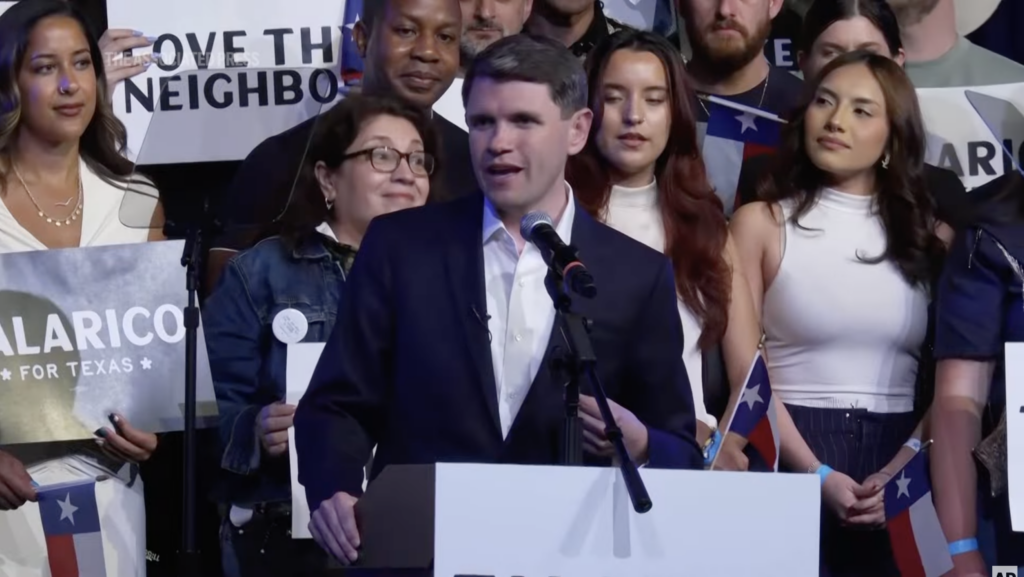
Texas state Rep. James Talarico won the Democratic primary for the U.S. Senate on Tuesday, drawing significant attention for his open embrace of Christianity during his campaign. This development has sparked a broader debate over how media outlets portray expressions of faith in politics, particularly in contrasting coverage of Democrats and Republicans. The core tension lies in the differing narratives surrounding Christian nationalism, with critics arguing that the media often frames Democratic expressions of faith positively while depicting Republican ones as dangerous or extremist. Talarico's campaign has been characterized by a message of compassion and inclusivity, which some media outlets have celebrated as a potential shift in American politics.
Talarico's victory is notable in a political landscape where the intersection of faith and politics is often contentious and fraught with division. Major news outlets have highlighted his approach as a refreshing change, with some commentators suggesting it could reshape perceptions of religious involvement in politics. This shift could signal a new era where faith is more openly discussed and embraced within the Democratic Party, potentially attracting a broader base of voters who value both faith and progressive ideals.
Positive Media Portrayal
In an op-ed for MS Now, Guthrie Graves-Fitzsimmons praised Talarico, stating, "James Talarico is living up to the hype – by staying true to his faith." He described Talarico as a rising star who could redefine how faith is perceived within the Democratic Party. Graves-Fitzsimmons argued that Talarico's campaign demonstrates that a religiously fluent Democrat can resonate with voters, suggesting that faith does not have to be excluded from public life or political discourse. This positive framing contrasts sharply with how similar expressions of faith are treated when associated with Republican figures. For instance, a 2022 episode of The Rachel Maddow Show characterized Christian nationalism as a threat, particularly when linked to Republican policies. Critics argue that this discrepancy reflects a broader media bias that favors Democratic narratives over Republican ones.
The Double Standard
Christian Paz of VOX noted that Talarico’s approach combines progressive Christianity with a populist economic message, stating, "Talarico’s brand of compassionate progressive Christianity... has attracted the most attention in and out of the state." He emphasized that Talarico's faith is acceptable because it aligns with Democratic priorities, contrasting it with the alarm raised over Republican figures who invoke their faith in support of conservative policies. This pattern of media coverage raises important questions about the underlying assumptions regarding faith in politics. While Talarico's use of scripture to support policies such as abortion rights and LGBTQ protections has been framed as a positive development, similar uses of faith by Republicans are often met with skepticism and criticism.
Criticism of Talarico's Position
Despite the favorable coverage, Talarico's positions have not gone unchallenged. Critics, including Jordan Boyd from The Federalist, have pointed out that Talarico's interpretation of scripture to support abortion rights is problematic. Boyd stated, "Just because Jesus didn’t specifically use the word ‘abortion’... doesn’t mean he has nothing to say about it." This highlights the ongoing debate over the appropriateness of using religious texts to justify political stances and policies. Talarico's campaign has not yet responded to these criticisms, leaving some observers questioning the implications of his positions on traditional Christian doctrine. The media's celebratory tone surrounding Talarico's faith raises concerns about whether similar scrutiny would be applied to Republican candidates who invoke their faith in support of conservative agendas.
Conclusion
As Talarico moves forward in his campaign, the contrasting narratives surrounding faith in politics will likely continue to be a focal point of discussion. The media's portrayal of Talarico as a progressive Christian leader may influence how voters perceive the role of faith in the Democratic Party, while also prompting further examination of the implications of Christian nationalism in American politics. The ongoing discourse around Talarico's candidacy underscores the complexities of faith in the political arena, particularly as it relates to party affiliation and policy priorities. As the election approaches, how these narratives evolve will be crucial in shaping voter perceptions and the broader political landscape, potentially influencing the outcomes of future elections.