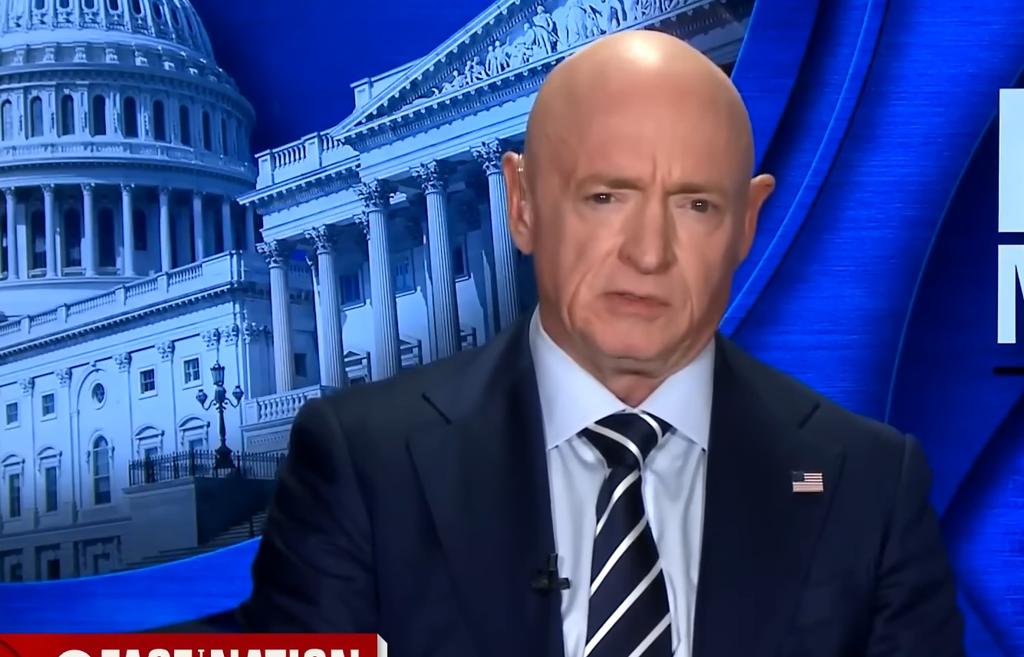
The Department of War announced Monday that it has launched an investigation into Sen. Mark Kelly, D-Ariz., for his participation in the 'Seditious Six' video, in which Democrat lawmakers encouraged military members to ignore orders from President Donald Trump, their commander-in-chief. Kelly, a retired Navy captain, could be called back into active duty service to face 'court-martial proceedings or administrative measures,' according to the Pentagon.
War Secretary Pete Hegseth criticized the video, calling it 'despicable, reckless, and false,' stating that it undermines 'every aspect of good order and discipline.' He emphasized that encouraging military personnel to disregard their commanders puts them in danger. The video features remarks from Reps. Chris Deluzio, D-Penn., and Jason Crow, D-Colo., who claimed that 'threats to our Constitution aren’t just coming from abroad, but from right here at home.' Following this, Kelly stated, 'Our laws are clear: You can refuse illegal orders,' without specifying which orders he deemed illegal.
Hegseth noted that five of the six Democrats in the video are not under military jurisdiction, although four are former military personnel. Kelly's retired status, however, subjects him to the Uniform Code of Military Justice, specifically 10 U.S.C. § 688, which allows military secretaries to recall retired members under certain circumstances.
The Pentagon also referenced federal law 18 U.S.C. § 2387, which prohibits actions intended to interfere with the loyalty, morale, or good order and discipline of the armed forces. It remains unclear if this law implicates Deluzio, Crow, or the other lawmakers involved, including Sen. Elissa Slotkin, D-Mich. (former CIA officer), and Reps. Maggie Goodlander, D-N.H. (former Navy intelligence), and Chrissy Houlahan, D-Penn. (former Air Force).
The law broadly states that anyone who advises or attempts to cause insubordination or disloyalty among military members could face fines or imprisonment of up to ten years, along with ineligibility for federal employment for five years following a conviction. The Pentagon reiterated that a servicemember's personal beliefs do not justify disobeying lawful orders.
Kelly's office did not respond to a request for comment from The Federalist. However, he posted a statement on his official X account, appealing to his military service and including a photo of his uniform, without addressing the allegations of sedition. He stated, 'If this is meant to intimidate me and other members of Congress from doing our jobs and holding this administration accountable, it won’t work.' He added, 'I’ve given too much to this country to be silenced by bullies who care more about their own power than protecting the Constitution.'
The situation has drawn attention, with some commentators noting the irony of Kelly's defense, suggesting it inadvertently supports arguments against inciting insurrections and military coups. The investigation into Kelly's actions reflects broader concerns about the conduct of elected officials and their influence on military personnel, particularly in politically charged environments.