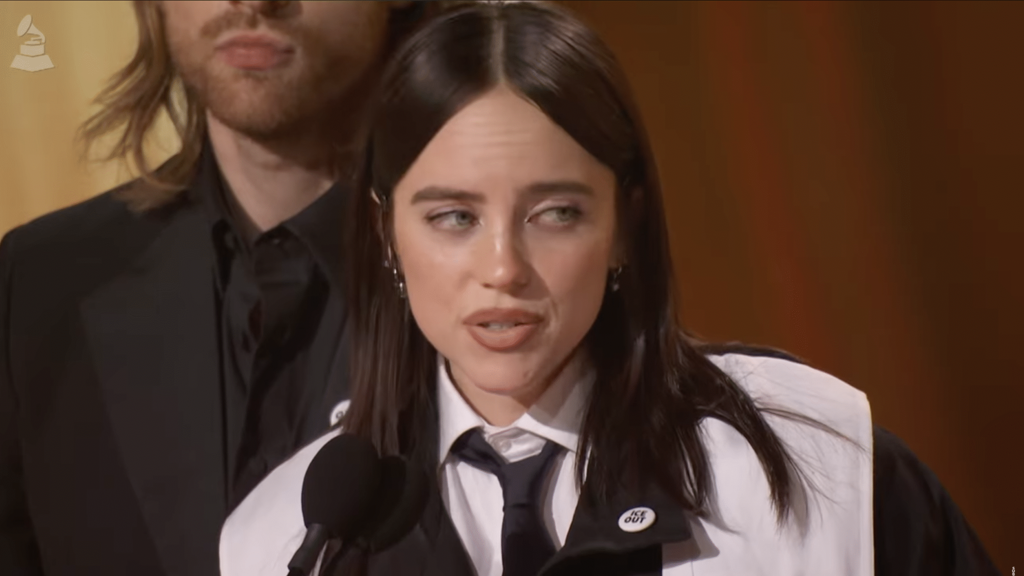
Billie Eilish's acceptance speech at the Grammy Awards has ignited significant controversy regarding her views on immigration and personal safety. While receiving the prestigious award for Song of the Year, Eilish made a notable statement, declaring, "no one is illegal on stolen land," and expressed her disdain for U.S. Immigration and Customs Enforcement (ICE), emphatically stating, "F-ck ICE." This bold declaration has sparked a heated debate about the implications of her words.
The tension arises from Eilish's public stance on immigration, which critics argue contrasts sharply with her personal actions aimed at securing her own safety. Eilish has previously sought legal protection from a stalker, highlighting a complex relationship with the concept of borders and enforcement. This duality in her beliefs raises questions about the consistency of her views on safety and legality.
In 2023, Eilish obtained a restraining order against Shawn Christopher McIntyre, a 53-year-old man who allegedly sent her and her family hundreds of threatening messages. Reports indicate that Eilish experienced significant anxiety and fear for her safety, particularly after witnessing McIntyre near her home. This situation underscores the very real threats that individuals can face, regardless of their public persona or beliefs.
Legal Protection and Personal Boundaries
Eilish's actions reflect a desire for government intervention when her safety is at risk. She sought a restraining order to keep McIntyre at least 100 yards away from her residence, a legal measure that underscores her belief in the necessity of boundaries. This contrasts sharply with her Grammy remarks, which seem to dismiss the concept of borders in a broader societal context. Critics point out the apparent hypocrisy in Eilish's statements. When discussing immigration, she advocates for open borders, yet when faced with a personal threat, she turns to the government to enforce her property rights. This duality raises questions about the consistency of her views on safety and legality.
Public Reaction and Perspectives
The backlash to Eilish's comments has been swift and vocal, with many social media users highlighting the contradiction between her public statements and her private actions. Some commentators argue that her remarks reflect a broader trend among celebrities who advocate for lenient immigration policies while enjoying the protections afforded by their wealth and status. This perceived hypocrisy has led to a divide in public opinion regarding her stance.
Supporters of Eilish, however, argue that her comments are intended to provoke thought about systemic issues related to immigration and land ownership. They contend that her artistic platform allows her to challenge conventional narratives and encourage dialogue about these complex topics. They believe that her remarks are not merely self-serving but rather a call to examine the deeper implications of immigration policies and societal structures.
As of now, Eilish has not publicly addressed the criticisms regarding her remarks and their implications for her personal situation. The lack of response leaves room for further debate about the intersection of celebrity activism and personal safety. This silence may contribute to the ongoing discourse surrounding her comments and the broader implications they hold.
Broader Implications
Eilish's Grammy speech and subsequent legal actions highlight a significant cultural conversation about the balance between personal safety and broader societal issues. While she advocates for a more inclusive view of immigration, her reliance on legal protections raises questions about the practicality of such ideals in real-life situations. The ongoing discourse surrounding Eilish's comments serves as a reminder of the complexities involved in discussions about borders, safety, and the responsibilities of public figures. As the debate continues, it remains to be seen how Eilish will navigate the fallout from her statements and whether she will reconcile her public persona with her private needs. The intersection of celebrity influence and personal safety remains a contentious topic, inviting further exploration and discussion in the public arena.