A federal judge in Honolulu has permanently blocked a Hawaii law that sought to regulate online political satire, declaring it unconstitutional. Judge Shanlyn A.S. Park's ruling came in response to a lawsuit filed by the conservative satire site The Babylon Bee and Hawaii resident Dawn O’Brien, who argued that the law would infringe on their First Amendment rights.
Explainer Free Speech Battles: Courts, Censorship, and Cultural Conflicts
The core issue at stake is the balance between regulating potentially misleading political content and protecting free speech. The law, signed by Democratic Governor Josh Green in July 2024, aimed to prohibit the distribution of what it termed "materially deceptive media," which could harm the reputation or electoral prospects of political candidates. Critics of the law contended that it would effectively censor satire and parody, both of which are longstanding forms of political expression.
The law was set to take effect on Monday and would have required satirical content to carry disclaimers indicating that it was not factual. First-time violators could face fines of up to $1,000 and possible imprisonment, with penalties increasing for subsequent violations. The Babylon Bee argued that such disclaimers would fundamentally alter the nature of their work, with Park noting in her ruling that a mandatory disclaimer would "kill the joke."
Key Details
"We use comedy to speak about current events in a way others can’t, and Hawaii is robbing us of that voice," said Seth Dillon, CEO of The Babylon Bee, in a December press release. He emphasized that the First Amendment protects their right to create satire, regardless of the political climate.
Background and Reactions
The law's proponents, including Hawaii Attorney General Anne Lopez, argued that it was necessary to combat the spread of misinformation, particularly in the context of elections. They claimed that the law would help prevent the distribution of deceptive content that could mislead voters. However, the judge's ruling highlighted concerns about the potential for biased enforcement of such regulations.
In her 38-page opinion, Park stated, "Political speech, of course, is at the core of what the First Amendment is designed to protect. Rather than require actual harm, [the law] imposes a risk assessment based solely on the value judgments and biases of the enforcement agency." This raises questions about how such laws might be applied in practice.
The law was passed with overwhelming support in a legislature dominated by Democrats, reflecting a broader trend across the country. According to the National Conference of State Legislatures, 26 states had enacted laws regulating political deepfakes or deceptive media as of December 2025. These laws vary in their approach, with some states requiring disclosures or outright banning certain types of content.
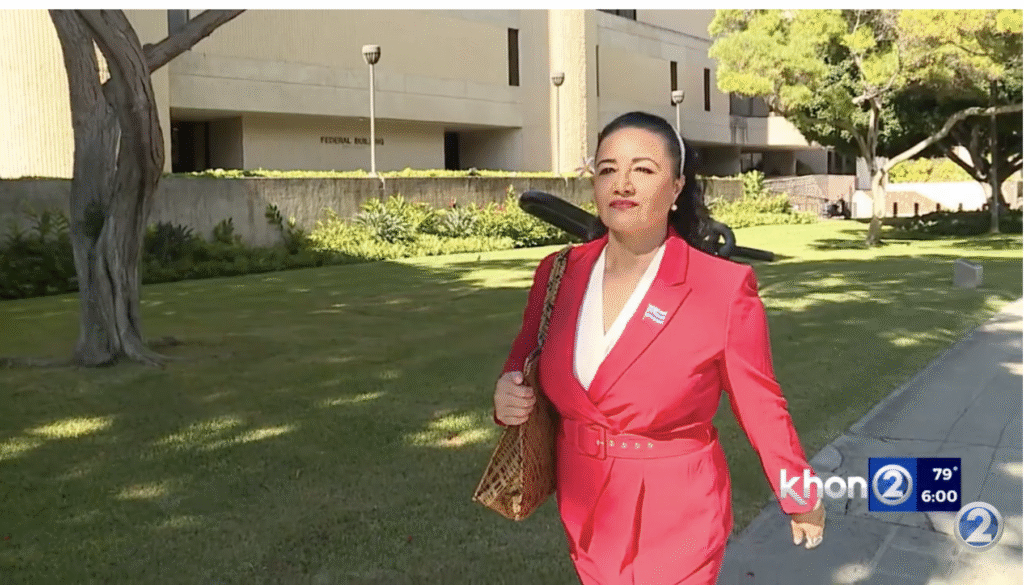
O’Brien, who also joined the lawsuit, expressed concern about the implications of the law for political discourse in Hawaii. She noted that her own content had previously drawn scrutiny from state officials due to her criticisms of Governor Green's policies. O’Brien stated, "Our governor and lawmakers are trying once again to steal inalienable rights from our Hawai’i ‘ohana’—our family and community. That is not Aloha nor is it Hawai’i."
The ruling marks a significant victory for free speech advocates, following similar legal challenges in California where courts struck down laws restricting online political speech. The outcome in Hawaii underscores the ongoing debate over the regulation of political content in the digital age and the potential risks to First Amendment protections.
While the state has not yet responded to the ruling, the decision may prompt further discussions about the balance between regulating misinformation and preserving free expression. As the political landscape continues to evolve, the implications of this ruling could resonate beyond Hawaii, influencing similar legislative efforts in other states.