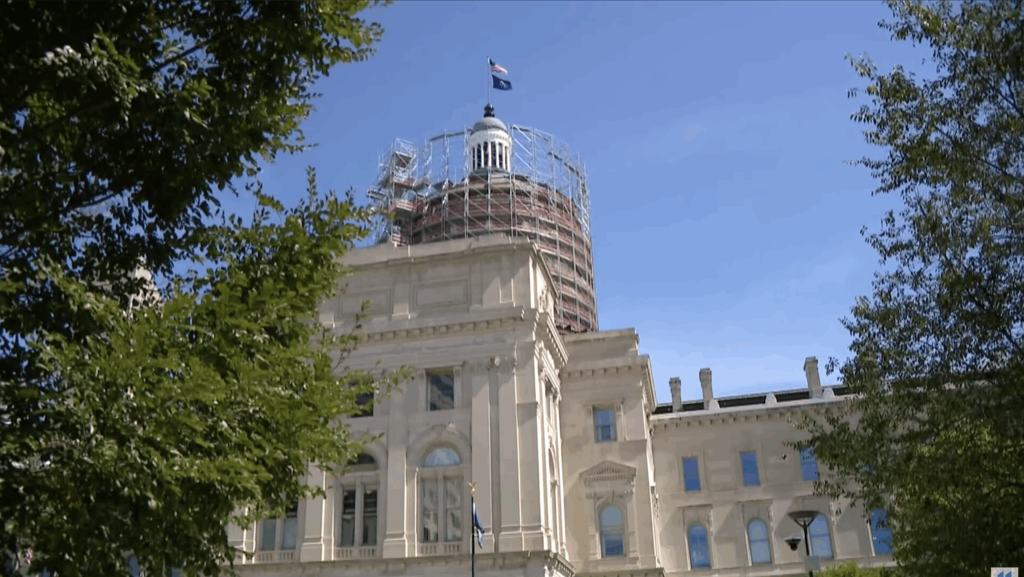
On Monday, Indiana Governor Mike Braun announced a special legislative session aimed at redistricting the state's nine congressional seats, two of which are currently held by Democrats. This initiative is part of a broader national effort to address perceived imbalances in congressional representation, particularly in states where Democrats have controlled the redistricting process for years. Braun stated, "I am calling a special legislative session to protect Hoosiers from efforts in other states that seek to diminish their voice in Washington and ensure their representation in Congress is fair."
Currently, Indiana has seven Republican-held congressional seats and two Democrat-held seats, reflecting a state where 59 percent of voters supported Donald Trump in the 2024 presidential election. State Senator Liz Brown highlighted the disparity, noting that Indiana's voter balance is similar to that of Massachusetts, which has no Republican representation in its congressional delegation despite a significant portion of Trump voters.
"They’re going to pack in illegal immigrants into those districts, and they’re going to rob congressional seats from not only the United States as a whole but also from the rural parts of their state."
— State Representative Matt Commons
Mollie Hemingway, Editor-In-Chief of The Federalist, remarked on Fox News that Democrats have effectively maximized their advantages in states they control, while Republicans have been slower to respond. This has led to a situation where many states, particularly those with Democratic majorities, have gerrymandered districts to protect incumbents.
The issue of gerrymandering is not confined to Indiana. States like Massachusetts, Illinois, and Connecticut have seen similar patterns, with no Republican representation in congressional or Senate seats despite substantial support for Republican candidates in recent elections. Illinois, in particular, has been criticized for its heavily gerrymandered maps, which have made it difficult for Republican candidates to compete effectively.
In response to Texas Republicans' plans to adopt a new congressional map that could add five Republican seats, California Governor Gavin Newsom is also moving to redraw his state's maps further. A measure on the November ballot, Proposition 50, would allow California's legislature to implement a new map between 2026 and 2030, potentially offsetting Republican gains from Texas.
State Representative Matt Commons expressed concerns about the impact of "sanctuary cities and states" on congressional representation, arguing that these areas could unfairly influence apportionment by including illegal immigrants in census counts. He stated, "They’re going to pack in illegal immigrants into those districts, and they’re going to rob congressional seats from not only the United States as a whole but also from the rural parts of their state."
Republican U.S. Representative Marlin Stutzman emphasized the importance of redistricting for Indiana, arguing that failing to do so would leave the state at a disadvantage in Washington, D.C. Stutzman compared the situation to the Revolutionary War, suggesting that Republicans need to adapt their strategies to compete effectively against Democrats.
The White House has reportedly encouraged Indiana to pursue redistricting, but there are indications that support within the Republican-majority Senate may be lacking. Commons expressed disappointment over the Senate's hesitance, noting that the body has often prioritized special interests over the needs of Republican voters.
As the debate continues, Brown remains hopeful that Senate leadership can facilitate the redistricting process, emphasizing the need for Republicans to unite in the face of ongoing challenges. She stated, "We need to acknowledge the decades of data that is being presented to us, whether it is about flaws with the last census or the fact that states like Massachusetts have eliminated Republican representation for decades."