TLT Explains
Justice Clarence Thomas Becomes Second-Longest Serving Supreme Court Justice in U.S. History
What's happening
Justice Clarence Thomas has officially become the second-longest serving justice in the history of the U.S. Supreme Court, surpassing Justice Stephen J. Field. At 77 years old, Thomas has served on the nation’s highest court for over 34 years since his appointment on October 23, 1991. His tenure places him just behind Justice William O. Douglas, who holds the record for the longest service. If Thomas remains on the bench until May 2028, he will become the longest-serving justice in Supreme Court history, further extending his influence on American jurisprudence.
Thomas’s rise to this milestone reflects a remarkable journey from a challenging childhood in segregated Georgia to the pinnacle of the American legal system. Born into poverty in Pin Point, Georgia, he was sent to live with his grandparents in Savannah, where he experienced firsthand the realities of racial discrimination and economic hardship. His early life was marked by significant obstacles, including a departure from his Catholic upbringing and a period of radical leftist ideology during his college years. However, a transformative experience at Harvard Law School led him to renounce those views and embrace a conservative judicial philosophy.
Before his Supreme Court appointment, Thomas served in several significant roles, including assistant secretary for Civil Rights at the Department of Education and chair of the Equal Employment Opportunity Commission. He was appointed to the D.C. Circuit Court of Appeals by President George H.W. Bush, a key stepping stone to his nomination to the Supreme Court in 1991. His confirmation process was contentious, involving intense scrutiny and allegations, but he ultimately secured his seat and has since become a defining figure on the Court.
Throughout his tenure, Thomas has been a steadfast proponent of originalism, a judicial philosophy that interprets the Constitution based on its original meaning at the time of ratification. This approach has shaped many of his opinions, including his influential concurrence in Printz v. United States in 1997, which laid the groundwork for future rulings on Second Amendment rights. His judicial philosophy was further reflected in landmark cases such as the 2008 D.C. v. Heller decision, which recognized an individual's right to possess firearms for self-defense, and the 2022 NYSRPA v. Bruen ruling, where he emphasized that the constitutional right to bear arms should not be treated as a second-class right.
What's at stake
Justice Thomas has also played a pivotal role in recent high-profile cases that have reshaped American law and society. Notably, he was part of the majority in the 2023 Students for Fair Admissions v. Harvard decision, which ruled affirmative action policies unconstitutional, and the 2022 Dobbs v. Jackson Women’s Health Organization ruling that overturned Roe v. Wade. These decisions have sparked widespread debate and highlighted the polarized nature of contemporary judicial issues. Supporters praise Thomas for his intellectual rigor and principled stance, while critics argue that his rulings sometimes overlook evolving societal needs and civil rights concerns.
Beyond his judicial work, Thomas is known for his personal warmth and kindness, traits that have earned him respect even among colleagues with differing views. Justice Sonia Sotomayor has remarked on his ability to connect with court staff by remembering their names and personal stories, demonstrating a humanizing side that contrasts with the often impersonal nature of Supreme Court deliberations. This personal dimension adds complexity to his public persona as a strict originalist jurist.
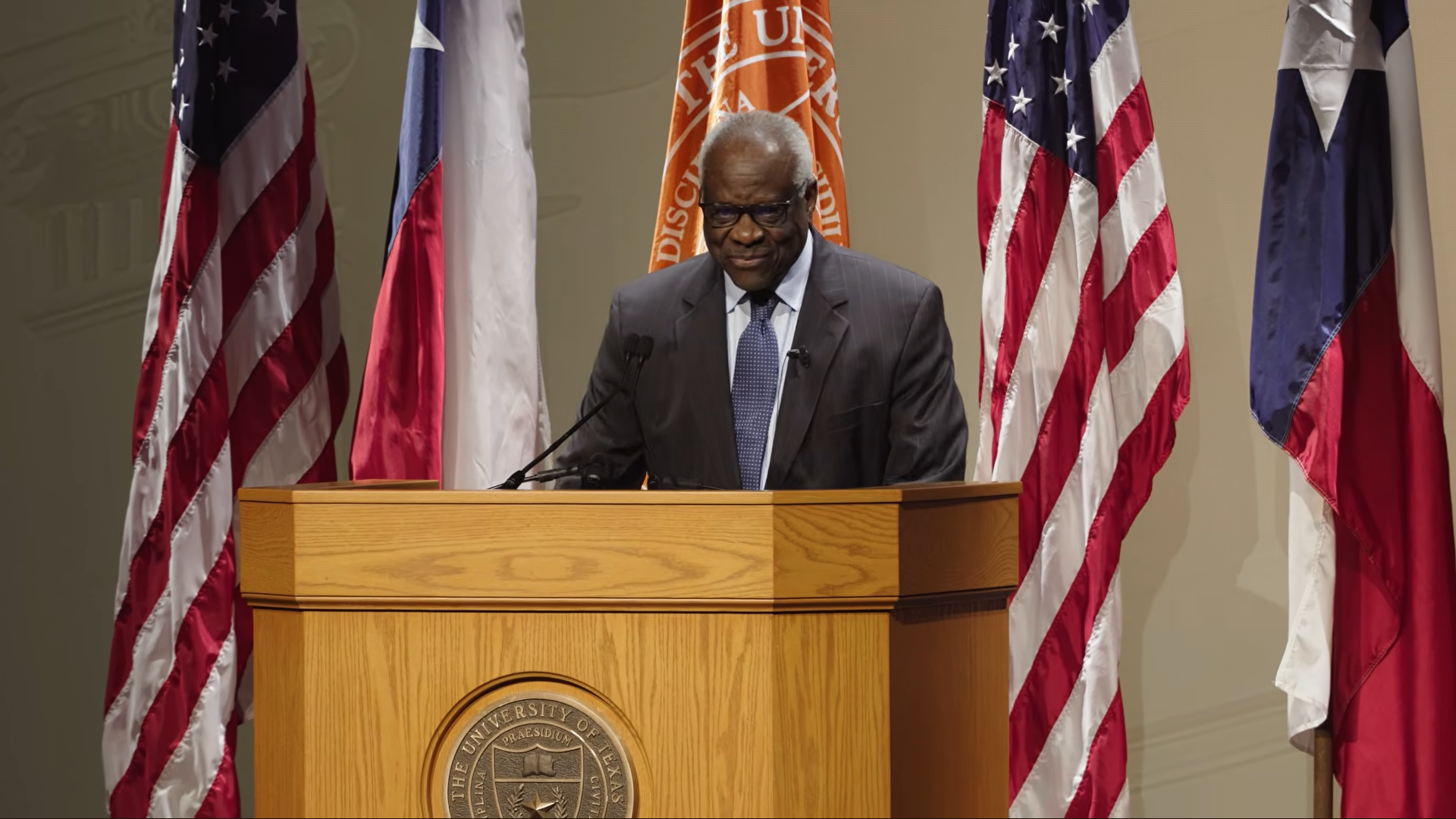
Thomas’s career has been marked by resilience and a commitment to principle. In a recent speech at the University of Texas, he encouraged listeners to embody courage and integrity, invoking the spirit of the Founding Fathers who signed the Declaration of Independence. His message emphasized standing firm in one’s convictions despite adversity, a reflection of his own journey through personal and professional challenges. This ethos continues to influence his approach to the law and his role on the Court.
As Justice Thomas approaches the possibility of becoming the longest-serving justice in Supreme Court history, his impact on the interpretation of the Constitution remains a focal point of legal and public discourse. His judicial philosophy and decisions will continue to shape debates on constitutional rights, civil liberties, and the balance of power in American government. Observers will be closely watching whether he chooses to remain on the bench through 2028 and how his legacy will influence future Court dynamics.
Looking ahead, the Supreme Court faces numerous significant cases that could further define Thomas’s judicial legacy. Issues related to constitutional interpretation, civil rights, and the scope of federal power are expected to dominate the docket. Additionally, as the Court’s composition evolves, Thomas’s role as a senior justice will be critical in shaping consensus or dissent. The legal community and the public alike will be attentive to how his tenure continues to affect the nation’s legal landscape in the coming years.
Why it matters
Justice Thomas’s milestone highlights the enduring influence long-serving justices have on Supreme Court decisions and American law. His originalist philosophy continues to shape key rulings on constitutional rights and federal authority. Thomas’s decisions in cases like affirmative action and abortion have significant social and political implications.
His personal story and judicial approach contribute to ongoing debates about the Court’s role in society. The length of his tenure raises questions about the impact of lifetime appointments on the judiciary’s evolution. His presence on the Court affects the balance of ideological perspectives and future legal interpretations.
Thomas’s legacy will influence how constitutional issues are debated and resolved for decades to come.
Key facts & context
Justice Clarence Thomas was appointed to the Supreme Court on October 23, 1991. He recently surpassed Justice Stephen J. Field to become the second-longest serving justice in U.S. Supreme Court history. Thomas is currently 77 years old and has served over 34 years on the Court.
If he remains until May 2028, he will become the longest-serving justice in Supreme Court history. He was appointed to the D.C. Circuit Court of Appeals by President George H.W. Bush before his Supreme Court nomination. Thomas is known for his originalist judicial philosophy, interpreting the Constitution as understood at the time of its ratification.
He has authored significant opinions on Second Amendment rights, including Printz v. United States and D.C. v. Heller. Thomas played a key role in the 2023 ruling that declared affirmative action policies unconstitutional in Students for Fair Admissions v. Harvard. He was part of the majority in the 2022 Dobbs v. Jackson Women’s Health Organization decision that overturned Roe v. Wade.
Justice Sonia Sotomayor has praised Thomas’s personal kindness and ability to connect with court staff. Thomas has publicly emphasized courage and integrity, encouraging individuals to stand firm in their convictions. His tenure and judicial philosophy remain central topics in discussions about the Supreme Court’s future direction.
Timeline & key developments
2026-05-07: Justice Clarence Thomas Becomes Second-Longest Serving Supreme Court Justice. Additional reporting on this topic is available in our broader archive and will continue to shape this timeline as new developments emerge.
Primary sources
Further reading & references
- (Additional background links will appear here as we cover this topic.)
Related posts
- Justice Kennedy's Memoir Sparks Debate on Judicial Philosophy
- Justice Samuel Alito Marks 20 Years on Supreme Court Amid Renewed Attention
- Justice Clarence Thomas Calls for Devotion to Founding Principles in Commemorative Speech
- Pew Research Study Challenges Media Claims About Supreme Court Precedent Overturns
- Justices Thomas and Alito Criticize SCOTUS for Not Hearing CDL Case Involving Unauthorized Immigrants