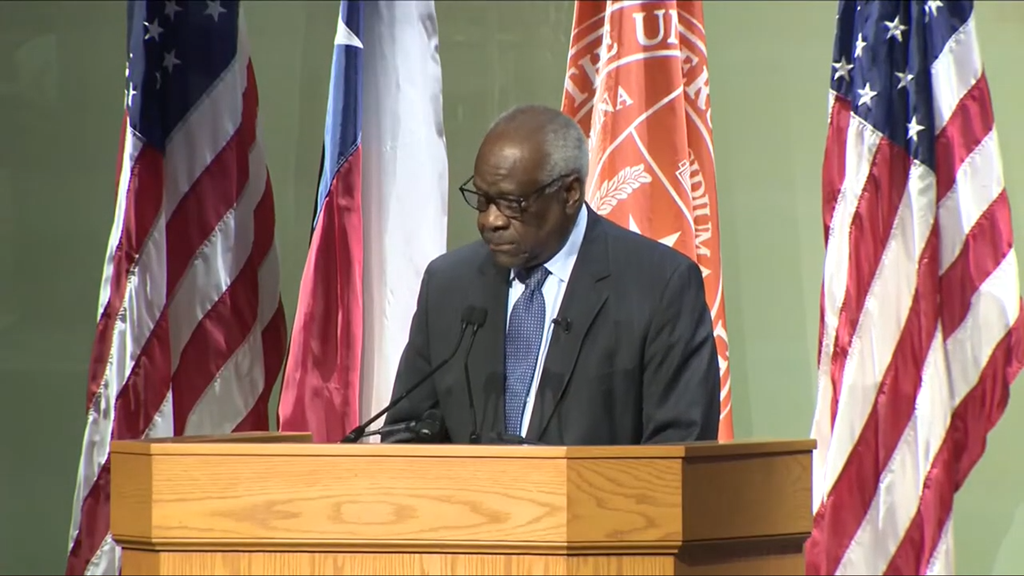
Justice Clarence Thomas delivered a powerful speech at the University of Texas on Wednesday, urging Americans to recommit to the principles outlined in the Declaration of Independence as the nation approaches its 250th anniversary. His remarks highlighted the importance of personal sacrifice and courage in preserving the ideals of equality and liberty, which he believes are foundational to the American identity.
Thomas's speech underscored a growing concern about the perceived erosion of these founding values in contemporary politics. He criticized what he described as a lack of commitment among leaders to uphold the principles that have historically defined the nation. This lack of commitment, he argued, threatens the very fabric of American democracy.
Drawing from his own experiences growing up in the segregated South, Thomas reflected on the significance of the Declaration's assertion that all men are created equal. "At home, at school, and at church, we were taught that we are inherently equal; that equality came from God, and that it could not be diminished by man," he said. This foundational belief, he argued, has been challenged by modern political ideologies that prioritize government over individual rights, leading to a distortion of the original intent of the Declaration.
A Call to Action
In his address, Thomas praised the Founding Fathers for their bravery in signing the Declaration, noting that their actions could have been seen as treasonous at the time. He emphasized that the true impact of the Declaration lies not just in its eloquent words but in the dedication of those who fought for its principles. "What changed the world was not the words, but the commitment and spirit of the people who were willing to labor, sacrifice, and even give their lives," he stated, highlighting the need for a similar spirit of dedication in today's society.
However, Thomas expressed concern that such devotion appears to be lacking in today’s political climate. He criticized political figures who, he claimed, pay "lip service" to founding ideals but fail to act when faced with challenges. He warned that many succumb to the pressures of public opinion, compromising their principles for the sake of popularity and political expediency. This trend, he suggested, undermines the integrity of the nation's foundational values.
Critique of Progressivism
The justice also took aim at progressivism, arguing that it fundamentally contradicts the Declaration's commitment to natural rights. "Progressivism seeks to replace the basic premises of the Declaration of Independence, and hence our form of government," he asserted. Thomas pointed to historical figures like President Woodrow Wilson as examples of this ideological shift, suggesting that it undermines the belief that rights are endowed by a higher power rather than granted by the government. This critique reflects a broader conservative concern about the implications of progressive policies on individual liberties.
While Thomas's critique of progressivism resonates with many conservatives, some scholars argue that the evolution of political thought is a natural part of a democratic society. They contend that the challenges posed by modern governance require adaptation rather than strict adherence to historical ideals. This ongoing debate highlights the complexity of maintaining a balance between tradition and progress in American political discourse.
Encouragement for Future Generations
In closing, Thomas urged Americans to embody the same courage displayed by the Founding Fathers. He encouraged listeners to respond to challenges with conviction and to prioritize principles over personal comfort. "Channel the courage of the men who faced down a king and signed [the Declaration]," he said, calling for a renewed commitment to the nation's founding ideals. This call to action serves as a reminder that the principles of liberty and equality require active participation and vigilance.
Thomas's remarks come at a time when discussions about the role of government and individual rights are increasingly prominent in American discourse. His call for a return to foundational principles may resonate with those who feel disillusioned by current political dynamics and the perceived drift away from core American values.
As the nation prepares to celebrate its 250th anniversary, Thomas's speech serves as a reminder of the ongoing struggle to uphold the values that have shaped the United States. The challenge, he suggests, lies not in a lack of understanding but in the willingness to act on those beliefs in the face of adversity. This commitment to action is essential for ensuring that the ideals of the Declaration continue to inspire future generations.