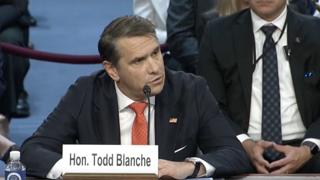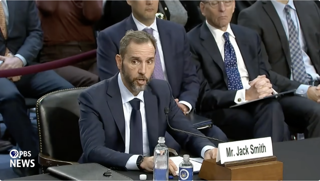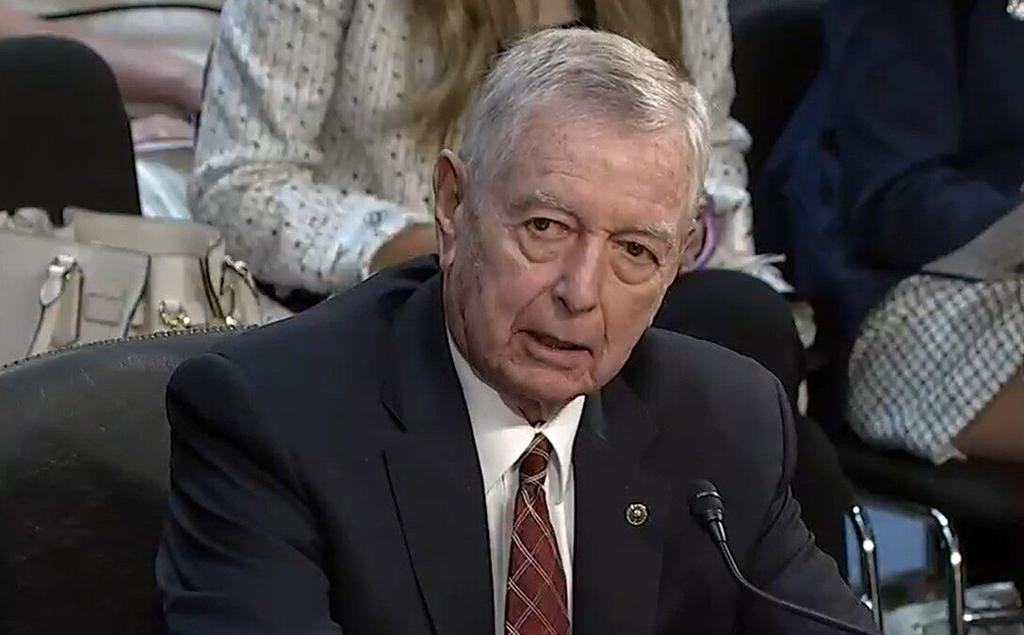
Former Attorney General John Ashcroft appeared before the Senate Judiciary Committee this week, defending the Department of Justice’s (DOJ) responsibility to prosecute individuals who break the law, regardless of their political ties or opposition to the president. Ashcroft’s testimony came during a hearing focused on the nomination of Acting Attorney General Todd Blanche to the permanent post, a process that has drawn sharp partisan scrutiny over the DOJ’s independence and the proper boundaries of executive authority in law enforcement.
The hearing, held in the Hart Senate Office Building, was part of the Senate Judiciary Committee’s ongoing review of Blanche’s nomination. Democratic senators, including Sens. Adam Schiff of California and Peter Welch of Vermont, pressed Ashcroft and Blanche on concerns that the Trump administration had used, or could use, the DOJ as a tool against political opponents. These concerns have been at the center of a broader debate over the politicization of federal law enforcement.
Schiff referenced reports that Blanche had allegedly commented on the president’s right and duty to direct DOJ action against his enemies, a characterization Blanche himself disputed during the hearing. In response to these questions, Ashcroft emphasized the attorney general’s obligation to enforce the law impartially, regardless of political considerations.
Ashcroft on Attorney General's Duty
“I believe that the Attorney General of the United States has the right and responsibility to enforce the law uniformly, and if the law has been broken by the president’s enemies, he has a duty,” Ashcroft said. He clarified that political opposition to the president does not exempt anyone from prosecution if they have violated the law. “They do not become exempt from following the law merely by their enmity to the President of the United States. As a matter of fact, the people who break the law are in enmity with the people of the United States, whose expression of what is the law has been developed in this body in the Congress of the United States — we used to call people who break the law public enemies,” Ashcroft stated.
Criteria for Law Prosecution
Ashcroft further explained that the determining factor for prosecution should be whether a law was broken, not the individual’s political relationship to the president. “Whether a person has been a political supporter or not of the President of the United States is not the determining factor regarding prosecution. It’s whether a person has violated the law,” he said.
Schiff continued to press Ashcroft on the issue, but Ashcroft maintained his position, reiterating the executive branch’s responsibility to enforce the law. “The President of the United States is the executive branch of the United States with whose charge it is to enforce the laws of the United States. When the President of the United States asks that the laws be enforced, I don’t see that as inconsistent with his duties or responsibilities,” Ashcroft said.
Sen. Welch shifted the focus to the now-defunct Anti-Weaponization Fund, which was intended to compensate victims of alleged DOJ abuses under the previous administration. Welch posed a hypothetical scenario involving conflicts of interest and large settlements, but Ashcroft declined to comment on the specifics, noting, “I didn’t have that situation. I didn’t have a president that had been the subject of illegal disclosure of his activities — criminal disclosure.”
Throughout the hearing, Ashcroft resisted attempts by Welch to interrupt his answers, insisting on providing his own account. “I swear to tell the truth, the whole truth, and nothing but the truth that’s that’s a big challenge in an oath, and so I want to give my answer and not your answer,” Ashcroft said.
As part of the committee’s review, letters of support for Blanche from former DOJ officials and law enforcement groups were entered into the record, according to the committee’s official hearing page. Blanche, for his part, disputed claims that he would use the DOJ to target political opponents, but Democratic senators continued to question the administration’s intentions and the potential for abuse of prosecutorial power.
The confirmation process for Blanche remains ongoing, with further committee review and debate expected in the coming weeks. The hearing underscored the persistent partisan divide over the DOJ’s role and the importance of maintaining impartial law enforcement, regardless of political pressures.
The debate over the DOJ’s independence is likely to continue as the Senate considers Blanche’s nomination and as broader questions about the intersection of politics and law enforcement remain at the forefront of national discussion.
For more information, see the committee’s official hearing page: https://www.judiciary.senate.gov/committee-activity/hearings/the-nomination-of-the-honorable-todd-blanche-to-be-attorney-general-of-the-united-states.