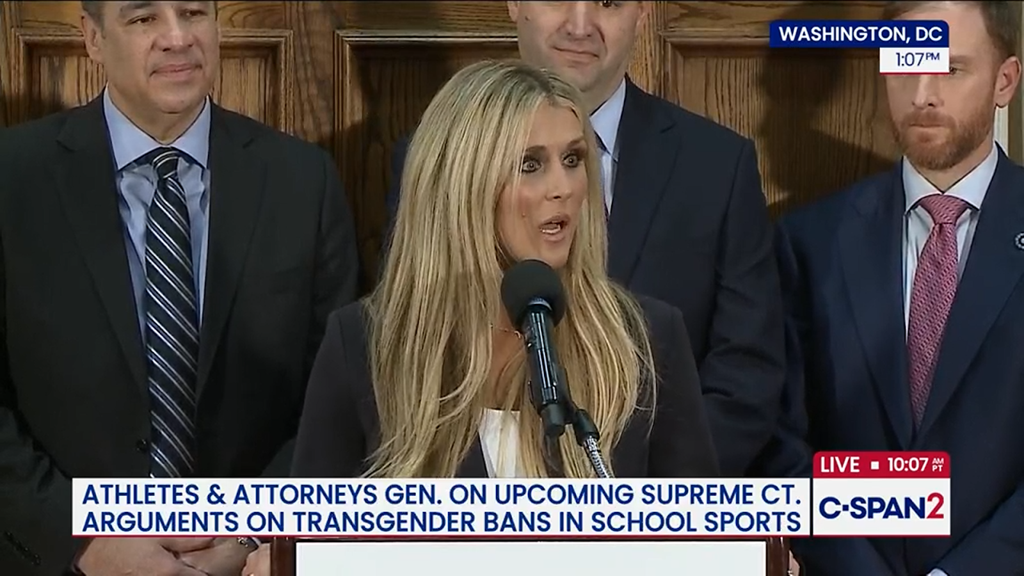
A coalition of female athletes and Republican attorneys general gathered in Washington, D.C., on Monday to advocate for the preservation of women’s sports ahead of the U.S. Supreme Court's consideration of related cases. This rally coincided with the court's oral arguments scheduled for Tuesday in two significant cases: Little v. Hecox and West Virginia v. B.P.J. These cases have garnered national attention due to their implications for the participation of transgender athletes in women's sports.
The core issue at stake is whether laws in Idaho and West Virginia that prohibit transgender women from competing in women’s sports violate the 14th Amendment’s equal protection clause and Title IX. Advocates for these laws argue that they are essential for protecting the integrity of women’s athletics. In contrast, opponents contend that such laws discriminate against transgender individuals and infringe upon their rights.
Former NCAA swimmer Riley Gaines, who spoke at the press conference hosted by the Republican Attorneys General Association, expressed her frustration over what she perceives as a political agenda that undermines women's rights. "I’m pissed off … that we’ve reached a point where we seemingly have an entire political party who has diminished and erased our rights as women," she stated emphatically. Gaines emphasized that allowing transgender women to compete in women’s sports has detrimental effects on female athletes, stating, "What me and what my teammates faced was not inclusive; it was exclusive."
Support from Republican AGs
The rally featured support from eight Republican attorneys general, including Raúl Labrador of Idaho and John McCuskey of West Virginia. McCuskey asserted that the laws in question are grounded in constitutional principles and common sense. "These laws make sense, they protect our women and girls, and we are all very proud to stand here to defend this very, very important issue," he said. This sentiment was echoed by Labrador, who highlighted Idaho's commitment to ensuring equal opportunities for women in sports. "I’m just proud that the state of Idaho is here, with the state of West Virginia and all these Republican AGs supporting common sense legislation," he stated. More than 20 state attorneys general have signed briefs in support of Idaho and West Virginia in their respective cases, indicating a significant backing for these legislative measures.
Background on the Cases
The Supreme Court's review of Little v. Hecox and West Virginia v. B.P.J. follows its recent decision in U.S. v. Skrmetti, where the court upheld a Tennessee law banning certain transgender-related medical procedures for minors. In that ruling, Chief Justice John Roberts emphasized that the court's role is not to judge the wisdom of laws but to ensure they comply with constitutional protections. This precedent may play a role in how the justices approach the current cases.
The upcoming oral arguments are expected to address whether the laws in Idaho and West Virginia infringe upon the rights of transgender individuals or if they serve a legitimate purpose in protecting women's sports. Critics of the laws argue that they perpetuate discrimination against transgender athletes and undermine their rights, while supporters maintain that the integrity of women’s sports must be preserved. They assert that allowing transgender women to compete against biological females creates an uneven playing field, which could disadvantage cisgender female athletes.
As the Supreme Court prepares to hear these cases, the implications of its decisions could have far-reaching effects on the landscape of women’s sports and the rights of transgender individuals. The justices are tasked with balancing the rights of female athletes with the rights of transgender individuals, a complex issue that has sparked significant public debate and division across the nation.
Oral arguments in Little v. Hecox and West Virginia v. B.P.J. are set to begin at 10 a.m. ET on Tuesday. Many observers are anticipating a ruling that could set a precedent for similar laws across the country. The outcomes of these cases may influence how states approach the participation of transgender athletes in sports moving forward, potentially reshaping the future of athletics for both women and transgender individuals alike.