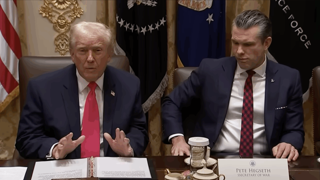
This week, President Donald Trump and Department of Homeland Security Secretary Kristi Noem indicated that the U.S. should continue to import foreign workers to fill jobs. During an interview with Fox News’ Laura Ingraham, Trump was asked if the H-1B visa program would be a priority for his administration, given concerns about raising wages for American workers. Trump responded that H-1B immigrants are necessary due to a lack of certain talents among American workers. Ingraham countered, asserting that there are plenty of talented individuals in the U.S. Trump insisted otherwise, stating, "No, you don’t have certain talents," and emphasized the need for skilled foreign workers to fill roles in industries such as manufacturing.
Trump's comments come in the wake of a recent immigration enforcement operation at a Hyundai plant in Georgia, which resulted in the arrest of hundreds of Korean workers. He suggested that without foreign workers, the U.S. would struggle to produce essential goods like batteries, implying that American workers lack the necessary skills.
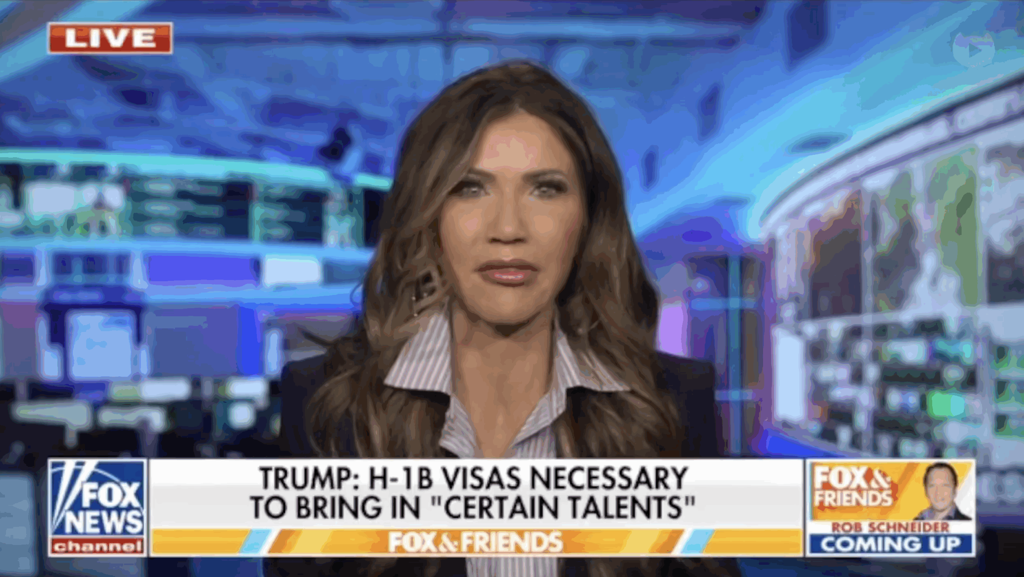
Critics argue that this stance contradicts Trump's America First agenda, which emphasizes national sovereignty and prioritizing American workers. They contend that relying on foreign labor undermines the goal of fostering domestic talent and innovation. Noem echoed similar sentiments on Fox & Friends, stating that the administration would continue to utilize visa programs while ensuring their integrity. She noted that more individuals are becoming naturalized citizens under the current administration, suggesting a commitment to legal immigration processes.
However, some commentators argue that if there is a genuine skills gap among American workers, the focus should be on reforming education and training programs rather than importing foreign labor. Vice President J.D. Vance has expressed skepticism about the notion that American citizens lack the talent to excel in various fields, rejecting the idea that the U.S. must rely on a foreign workforce.
The late Charlie Kirk also highlighted concerns about the decline of traditional social structures, advocating for measures such as reducing legal immigration and ending chain migration. He emphasized the need for policies that prioritize American citizens and their opportunities.
Historically, Trump has criticized the H-1B visa program, labeling it detrimental to American workers. In 2016, he stated that these visas were "very, very bad" and called for their elimination. Observers note a shift in his rhetoric, questioning whether his current stance aligns with the principles of America First.
As the debate continues, many are left wondering how the U.S. can balance the need for skilled labor with the imperative to invest in its own workforce. Ingraham's exchange with Trump serves as a reminder of the longstanding belief that America has thrived by relying on its own people. Advocates for an America First approach argue that prioritizing domestic talent is essential for the nation's future prosperity.