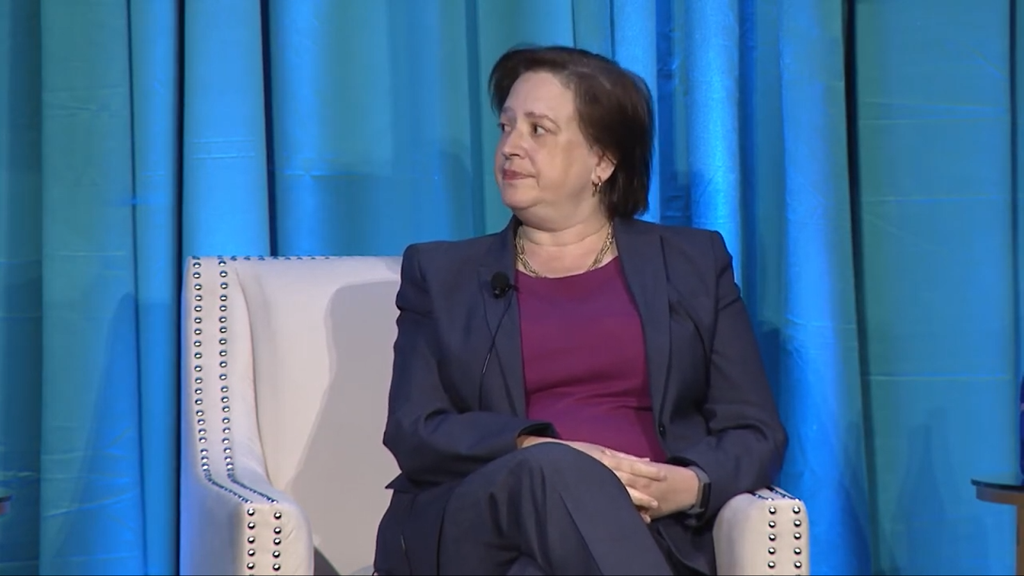
During a pivotal Supreme Court hearing on Wednesday, Associate Justice Elena Kagan attempted to dismiss the notion that Republicans face greater difficulty acquiring standing to challenge election rules than Democrats do.
The incident occurred during oral arguments in Bost v. Illinois State Board of Elections, a case centered on a 2022 lawsuit filed by Rep. Mike Bost, R-Ill., and two other Republicans against Illinois’ election board. The lawsuit challenges the legality of a state law permitting ballots to be accepted up to two weeks after Election Day. Bost and his co-plaintiffs had their suit dismissed by lower courts over alleged "lack of standing," (U.S. Supreme Court) prompting them to ask the Supreme Court to address whether they, as federal candidates, have pleaded sufficient factual allegations to show Article III standing to challenge state regulations concerning their federal elections.
"if you’re a candidate [or] you’re a party, of course you have standing."
— Paul Clement, attorney for Rep. Mike Bost
Acquiring standing to challenge election rules has been a persistent issue for Republicans in recent years. As reported by The Federalist, this issue was at the forefront of several prominent lawsuits filed contesting the 2020 presidential election cycle, as well as a case involving a challenge to then-President Biden’s executive order regarding economic relief.
Kagan appeared to downplay the standing issue during her questioning of Bost’s attorney, Paul Clement. She focused on the distinction between Republicans and Democrats, probing Clement on how "in a lot of these suits, it’s the parties that sue" (U.S. Supreme Court) and that, "as Justice [Samuel] Alito suggested, it’s usually fairly predictable what rules the RNC is going to sue on and what rules the DNC is going to sue on."
Clement responded that while both parties have their preferred and disfavored rules, the standing issue remains significant. He noted that Democrats often challenge rules that directly affect voters, allowing them to couple their lawsuits with voter claims, which can simplify the standing question for the courts.
In contrast, Clement argued that Republicans often challenge rules that allow for extended ballot counting, making it more difficult for them to establish standing without a direct voter connection. He stated, "the rules that the Democrats don’t like tend to operate negatively directly on voters." (U.S. Supreme Court)
Kagan acknowledged Clement's point but claimed that it does not prevent Republicans from making their claims in court. She asserted that "the RNC challenges most of these kinds of rules and, as far as I know, nobody has ever kicked it out of court on standing grounds." (U.S. Supreme Court)
Clement expressed uncertainty regarding Kagan's assertion but emphasized that it is significantly harder for Republicans to establish standing in these contexts. He urged a return to simplicity in determining standing for candidates and parties, stating, "if you’re a candidate [or] you’re a party, of course you have standing." (U.S. Supreme Court)
In his rebuttal, Clement highlighted a 2024 case, RNC v. Burgess, which was dismissed by a district court over lack of standing. This lawsuit challenged Nevada’s acceptance of ballots arriving up to four days after Election Day, illustrating the ongoing challenges faced by the RNC in election litigation.
Shawn Fleetwood is a staff writer for The Federalist and a graduate of the University of Mary Washington. He has previously served as a state content writer for Convention of States Action and his work has been featured in various outlets, including RealClearPolitics and Conservative Review. Follow him on Twitter @ShawnFleetwood.