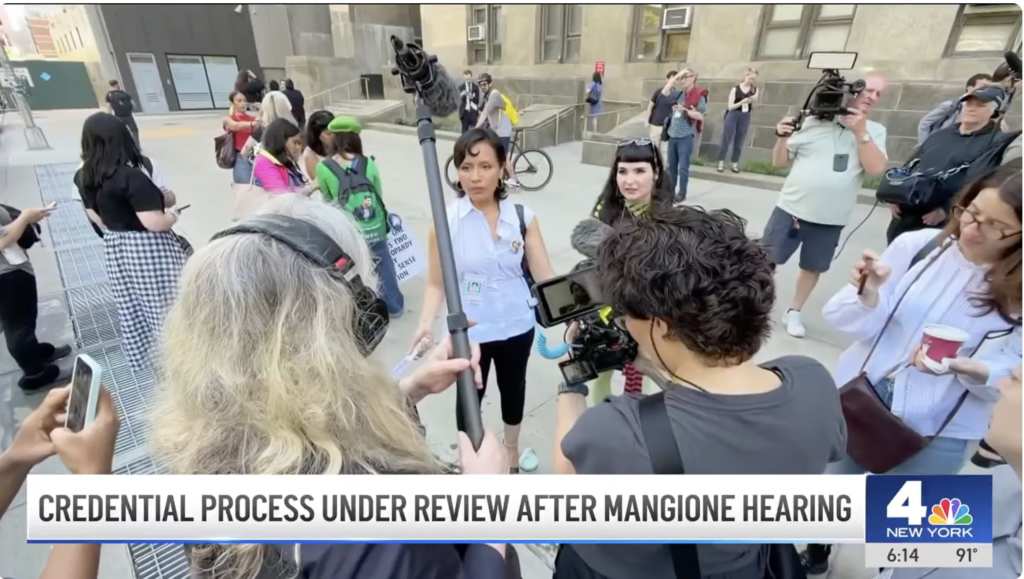
Three supporters of accused killer Luigi Mangione, who is facing charges for the December 2024 murder of UnitedHealthcare CEO Brian Thompson, received press passes to cover his recent court appearance in Manhattan. The trio, known as the "Mangionistas," have drawn significant criticism for their public expressions of support for Mangione and their comments regarding the murder, which have sparked outrage among various communities.
The situation raises serious questions about the glorification of violence in political discourse, particularly among some left-leaning groups. Critics argue that the actions and statements of the Mangionistas reflect a troubling trend of celebrating violence as a political tool, which could have far-reaching implications for societal norms and the political landscape.
Luigi Mangione, 29, is accused of shooting Thompson in the back, an act that has ignited widespread outrage and intense debate over the motivations behind such violence. During the court hearing, supporters Abril Rios, Ashley Rojas, and Lena Weissbrot were seen justifying the murder as a necessary act for their political beliefs. Rojas was quoted saying, "F— Brian Thompson, I don’t give a flying f— he died," while Weissbrot added, "His children are better off without him." Such statements have raised alarms about the normalization of violent rhetoric in political discussions.
Background on the Case
The murder of Brian Thompson has been described as particularly brutal, and the circumstances surrounding it have drawn significant media attention. Thompson's death has prompted discussions about the implications of political violence and the potential normalization of such actions among certain activist groups. The Mangionistas, who have been vocal in their support for Mangione, have been linked to leftist political movements. Rios, for instance, is associated with a campaign group called "Hot Girls for Zohran," which supported New York Mayor Zohran Mamdani. Critics have pointed out that such affiliations raise concerns about the intersection of political activism and violence, suggesting that the lines between protest and aggression are becoming increasingly blurred.
Reactions and Concerns
The reactions to the Mangionistas' behavior have been mixed. Some commentators have expressed alarm at the normalization of violent rhetoric, suggesting that it undermines civil discourse and could lead to a more polarized society. A YouGov poll indicated that a notable percentage of individuals identifying as "very liberal" believe that violence can be an acceptable means to achieve political ends. This statistic has fueled concerns about the radicalization of political discourse and the potential for violence to be seen as a legitimate form of expression.
Supporters of the Mangionistas argue that their expressions are a form of political protest rather than an endorsement of violence. They contend that such statements are intended to provoke thought and discussion about the state of political affairs. However, critics maintain that celebrating a murder is a dangerous precedent that could lead to further acts of violence and a deterioration of societal norms. No official response has been provided by Mayor Mamdani or other city officials regarding the controversy surrounding the press passes granted to the Mangionistas, leaving many to wonder about the implications of such actions.
The Broader Implications
The case of Luigi Mangione and his supporters highlights a growing divide in American political culture, where some factions appear to embrace violence as a means of expression. The actions of the Mangionistas have been likened to historical instances of political violence, raising concerns about the potential for similar movements to gain traction in the current political climate. As the trial progresses, the implications of this case may extend beyond the courtroom, influencing public perceptions of political activism and the boundaries of acceptable discourse.
The ongoing debate surrounding the Mangionistas underscores the need for a careful examination of how political beliefs can intersect with acts of violence, and what that means for society as a whole. As discussions about the role of violence in political expression continue, it becomes increasingly important to consider the potential consequences of normalizing such behavior and the impact it may have on future generations. The case serves as a reminder of the delicate balance between free expression and the responsibility that comes with it in a democratic society.