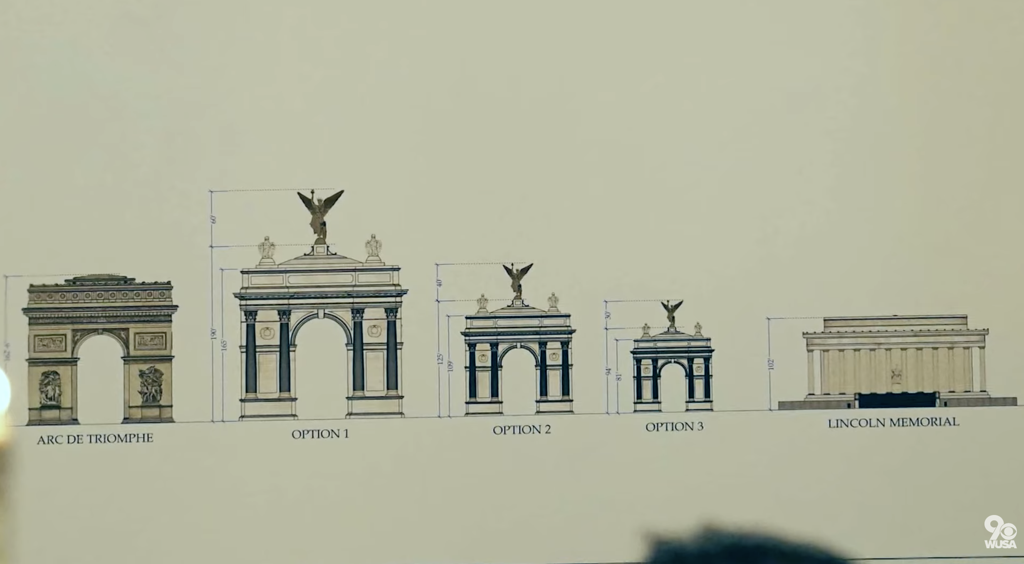
Former President Donald Trump recently unveiled designs for a proposed triumphal arch to be constructed in Virginia’s Memorial Circle. This arch is intended to visually connect the Lincoln Memorial and Arlington National Cemetery, serving as a significant monument to commemorate America’s 250th birthday. However, the project has already drawn criticism from various members of the artistic community and beyond.
The controversy surrounding the proposed arch highlights a broader cultural clash over architectural aesthetics. Critics argue that Trump’s preference for classical design reflects a regressive view of art and public space, suggesting that such a focus is outdated. Supporters, on the other hand, contend that the arch addresses a long-standing public desire for more dignified and meaningful federal architecture that resonates with American values.
Trump shared the renderings of the arch on Truth Social, where he emphasized the importance of classical architecture in representing the ideals and values of America. Critics have responded dismissively to the proposal, including Rep. Katherine Clark of Massachusetts, who stated, "Americans cannot afford health care," implying that the focus on architectural beauty is misplaced given the pressing social issues facing the nation today.
Architectural Debate
The proposed arch has reignited discussions reminiscent of Trump’s 2020 executive order aimed at promoting neoclassical design for federal buildings. Critics of that initiative, including a New York Times editorial, argued that mandating a single architectural style could be seen as authoritarian. They warned against the dangers of limiting artistic expression and stifling creativity in public architecture.
Supporters of the triumphal arch argue that it symbolizes a return to traditional values and aesthetics that resonate with many Americans. They assert that the public has long expressed dissatisfaction with what they perceive as unattractive, federally funded architecture. Advocates believe that the arch could serve as a unifying symbol of national pride and historical continuity, providing a sense of identity and purpose.
Cultural Significance
Proponents of classical architecture, including some cultural commentators, argue that structures like triumphal arches are more than mere design choices; they embody a civilizational language that communicates historical meaning and values. For example, the Arch of Constantine is often cited as a model that fuses various cultural inheritances, reflecting the belief that history and public life are worthy of elevation and celebration.
Critics, however, often dismiss these views as nostalgic or out of touch with contemporary realities. They argue that the push for classical forms overlooks the complexities of modern society and the need for diverse artistic expressions that reflect a broader range of experiences. This tension between tradition and modernity continues to shape the discourse around public architecture and its role in society.
The Role of the Body in Architecture
The debate also touches on deeper philosophical questions about the human body and its representation in art and architecture. Advocates for classical forms argue that these designs honor the human experience, emphasizing proportion, symmetry, and hierarchy. They contend that such structures reflect a moral claim about dignity and order in society, suggesting that beauty in architecture can elevate the human spirit.
Conversely, contemporary art often challenges these notions, with some artists viewing the body as a medium for self-expression rather than a subject to be revered. This divergence raises important questions about the role of art in shaping cultural values and societal norms, as well as how architecture can reflect or challenge those values.
In light of these discussions, the triumphal arch proposal stands as a focal point for broader conversations about identity, history, and the future of public art in America. While critics may see it as a step backward, supporters view it as an opportunity to reaffirm the importance of beauty and meaning in public spaces. As the project moves forward, it remains to be seen how the public will respond and whether the arch will become a symbol of national pride or a point of contention in the ongoing debate over America’s architectural identity.