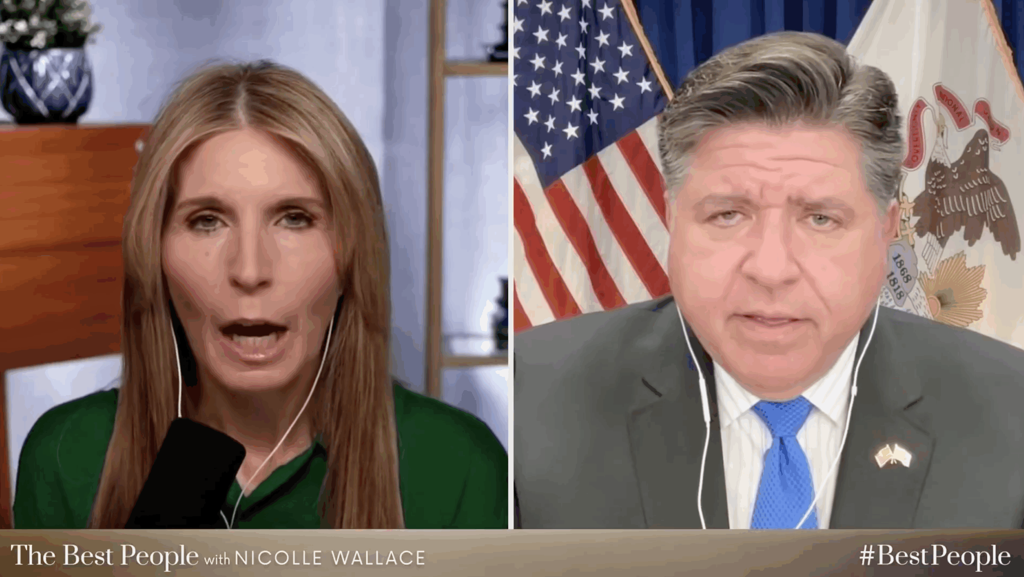
MSNBC’s Nicolle Wallace stated on Monday that she does not believe any Democrat has suggested that President Donald Trump is akin to Adolf Hitler. However, historical records indicate that several Democrats and their allies in the media have made such comparisons over the years. During an interview with Illinois Governor J.B. Pritzker, who expressed concerns about the rise of authoritarianism under Trump, Wallace suggested that comparing Trump to Hitler is not a partisan analysis. Pritzker, while discussing the implications of authoritarianism, refrained from directly labeling Trump as Hitler, stating, 'I’m not suggesting, I haven’t suggested that Donald Trump is Hitler.' Wallace interjected, claiming, 'I don’t think any Democrat has' made that comparison.
This assertion by Wallace has been challenged by various instances where Democrats have indeed likened Trump to Hitler. For example, Hillary Clinton, during a 2023 appearance on The View, warned that Trump’s reelection would signify 'the end of our country as we know it,' and noted that 'Hitler was duly elected.' Clinton's comments echoed sentiments shared by other prominent Democrats, including former House Speaker Nancy Pelosi, who stated that comparing Trump’s tactics to those of Hitler is 'very legitimate.'
Additionally, South Carolina Democrat Rep. James Clyburn has drawn parallels between the current political climate and Germany in the early 1930s, explicitly stating, 'That’s exactly what I’m saying, I said the 1930’s in Germany.' These comparisons have not been limited to politicians; media figures have also contributed to the narrative, with some suggesting that Trump has earned comparisons to Hitler.
Wallace herself has previously made similar comparisons, notably in 2018 when she remarked on Trump’s self-identification as a 'nationalist,' stating, 'I watch enough History Channel to know that they cheered at Hitler, too.' This history of rhetoric raises questions about the implications of such language, which some critics argue serves as a form of 'assassination prep' aimed at dehumanizing Trump and normalizing political violence against him.
The language used by Democrats and their media allies is often interpreted as an attempt to justify extreme measures against Trump, framing him as a dictator or tyrant. This narrative has been perpetuated through various media outlets, which have drawn parallels between Trump’s actions and those of historical authoritarian figures. The fearmongering surrounding Trump’s presidency has led to a polarized political environment, where language that evokes historical atrocities is employed to rally opposition.
Critics of this rhetoric argue that it not only misrepresents Trump’s policies but also risks inciting violence by portraying him as an existential threat to democracy. The use of such charged comparisons can desensitize the public to the potential consequences of political violence, as it creates a narrative that positions resistance as a moral imperative.
In summary, while Wallace claims that no Democrat has likened Trump to Hitler, the evidence suggests otherwise. The ongoing discourse surrounding Trump’s presidency is marked by a contentious exchange of ideas, where historical comparisons are frequently invoked to frame political debates. As the 2024 election approaches, the language used by both sides will likely continue to shape public perception and political engagement.