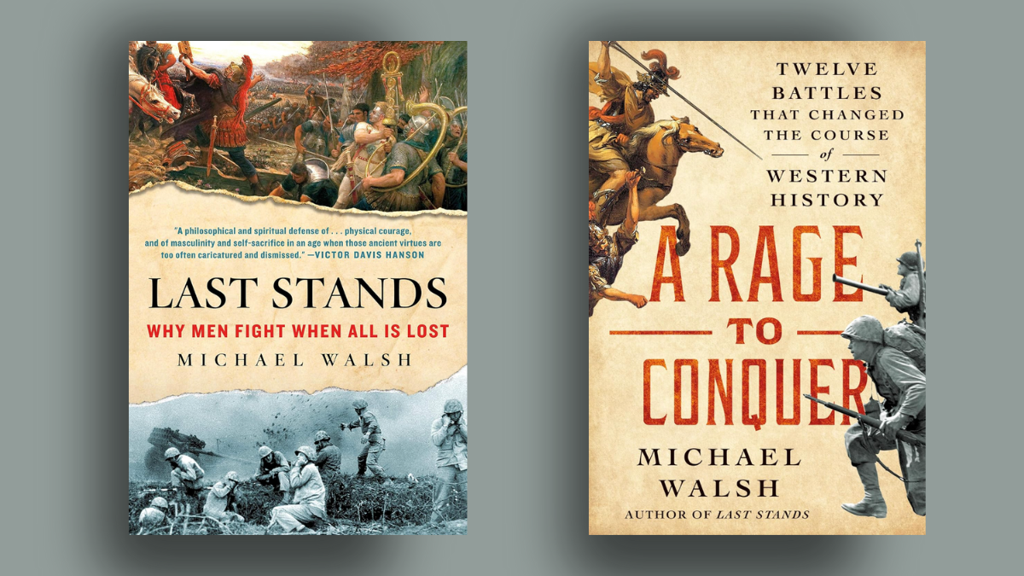
Michael Walsh's recent books, Last Stands: Why Men Fight When All is Lost and A Rage to Conquer: Twelve Battles That Changed the Course of Western History, offer a philosophical examination of war and its implications for manhood. Walsh argues that war is not merely a historical phenomenon but a fundamental aspect of the human condition, essential for understanding courage and virtue.
In his works, Walsh challenges contemporary views that often portray war as an aberration. He asserts, "War has been an essential part of the human condition as long as there has been a human condition," (U.S. Congress) emphasizing its role as a catalyst for societal change. This perspective positions war as a defining element of culture, from ancient civilizations to modern societies.
Walsh's exploration is deeply personal, drawing on his father's experiences as a Marine officer in the Korean War. He reflects on the archetype of the soldier, stating, "He immediately took command and has never relinquished it — as no real man ever does, at least not willingly, and except by death." (U.S. Congress) This personal narrative serves as a foundation for his arguments about the virtues of courage, endurance, and fidelity to duty.
The author presents a paradoxical view of defeat, suggesting that true valor often emerges in the face of inevitable loss. He recounts historical battles such as Thermopylae and the Alamo, where soldiers fought against overwhelming odds, embodying a spirit of resistance that transcends the outcomes of their struggles. Walsh contends that these acts of defiance affirm meaning in a seemingly chaotic world.
Critics of Walsh's perspective argue that his emphasis on martial virtue may overlook the complexities of modern warfare and the potential for peaceful resolutions. They caution against glorifying violence and suggest that a focus on courage should not dismiss the importance of diplomacy and dialogue in contemporary society.
Despite these criticisms, supporters of Walsh's philosophy maintain that his insights into courage and manliness are timely, particularly in an era where traditional values are often questioned. They assert that his works serve as a reminder of the importance of resilience and moral clarity in the face of adversity.
Walsh's reflections also touch on the broader implications of masculinity in modern culture. He posits that the crisis of manliness is at the heart of contemporary societal challenges, warning that a culture that neglects martial virtues risks its own survival. He states, "The only culture that doesn’t defend itself is one bent on suicide." (U.S. Congress)
In his analysis, Walsh draws parallels between historical warriors and modern society, suggesting that the lessons of the past remain relevant today. He emphasizes that courage is not merely a relic of history but a necessary quality for individuals and nations alike.
Ultimately, Walsh's works call for a reevaluation of how society perceives courage and manhood. He argues that the soldier's courage is a vital defense against nihilism and moral decay, asserting that the human spirit can triumph even in the darkest of times. As he concludes, the fight for virtue and humanity is an ongoing struggle that requires both recognition and action.
The Bottom Line
- Primary documents and sources are linked for verification.
- Walsh's books challenge contemporary views on war, presenting it as a fundamental aspect of human nature and a catalyst for societal change.
- His personal narrative, rooted in his father's military experiences, underscores the virtues of courage and duty in the face of adversity.
- The works provoke discussion on masculinity and the relevance of martial virtues in modern society, amidst criticisms of glorifying violence.