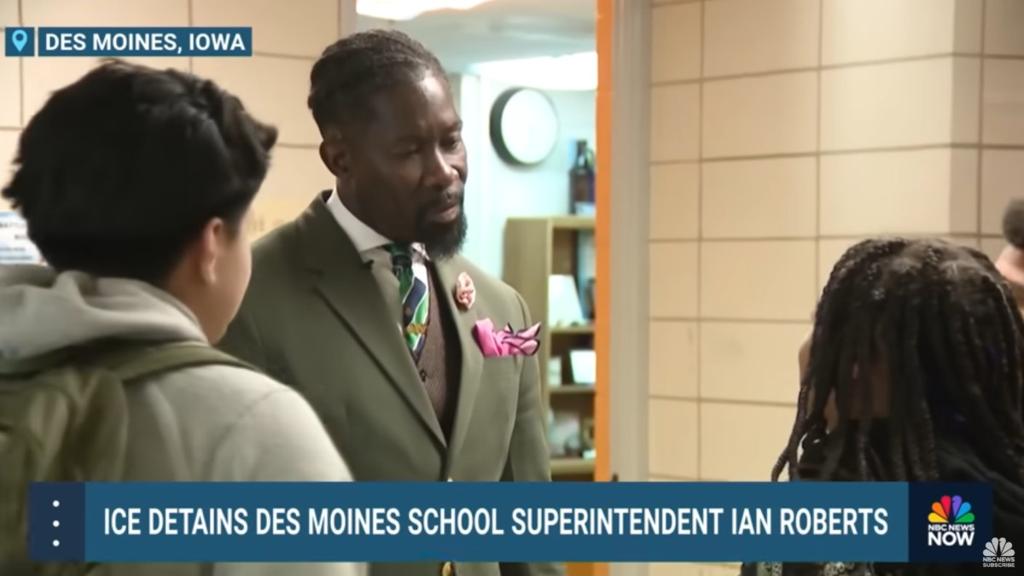
State officials revoked the license of Ian Roberts, the superintendent of Iowa's largest school district, on Monday after his arrest by U.S. Immigration and Customs Enforcement (ICE) on a deportation order and weapons charges. Roberts, who is from Guyana, was placed on paid administrative leave by the Des Moines school board while protests for his release took place.
ICE alleges that Roberts is an illegal immigrant who fled arrest in a school district-owned vehicle and was found in illegal possession of a loaded gun and a hunting knife. The Des Moines school board had previously appointed Roberts as the first person of color to lead the district in 2023. He is also registered as a Democrat voter in Maryland.
Roberts has faced previous legal issues, including past weapons possession charges, which he attributed to racial bias. He claimed to have a doctorate in education leadership, with a dissertation focused on “culturally responsive inclusion.” (Ice Arrests Criminal Alien Serving Des Moines Public Schools Superintendent Prior — ice.gov) However, public records indicate that he made numerous questionable claims about his background, including a supposed role in a security detail for Queen Elizabeth.
In the past five years, Roberts reportedly received over $1 million in salaries as a superintendent and settled lawsuits totaling $400,000 for alleged discriminatory hiring practices. Despite the lack of verified credentials, he was paid $183,000 annually for three years in a Pennsylvania school district.
Public Response and Political Implications
The situation has sparked significant public outcry, with thousands protesting outside the detention center where Roberts is being held. Many of the demonstrators are affiliated with the Democratic Party, advocating for the release of Roberts, who is accused of evading ICE while earning a taxpayer-funded salary exceeding $300,000.
Des Moines school board Chairwoman Jackie Norris, who is running for the U.S. Senate, has made education a key focus of her campaign. Critics argue that Roberts' case highlights systemic issues within American educational institutions and immigration policies. Roberts reportedly entered the U.S. on a student visa in 1999, raising questions about the verification processes for educators in public schools.
The controversy surrounding Roberts is seen as indicative of broader issues within the U.S. education system, where significant taxpayer funds are allocated without corresponding improvements in student achievement. In Des Moines, the district spends approximately $17,000 per student annually, yet many students perform below state averages in math and reading.
Roberts' strategic plan for the district emphasizes equity in education, a focus that some critics argue undermines merit-based achievement. The plan includes hiring practices based on identity rather than qualifications, which has raised legal concerns under Iowa's new law banning diversity, equity, and inclusion initiatives in public schools.
As the situation develops, it remains to be seen how it will impact the future of education policy in Iowa and beyond, as well as the political landscape leading up to the upcoming elections.